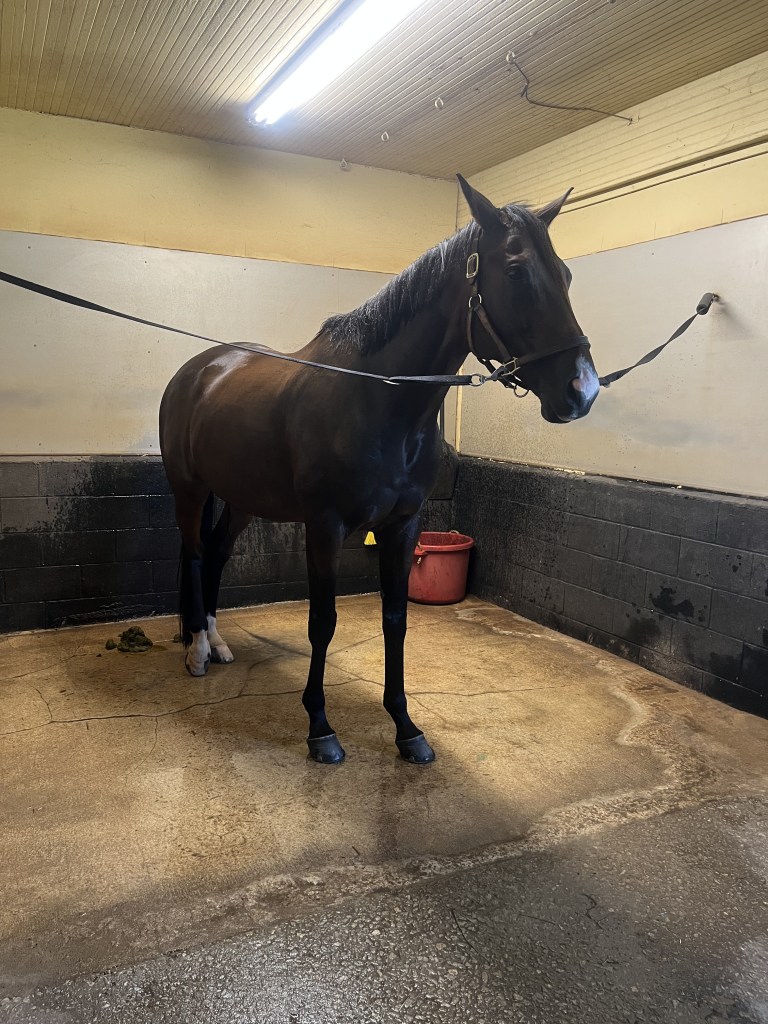
Today’s ride was fantastic and incredibly informative! I showed up at the barn ready and eager to ride! As I pulled into the parking lot, there was a lot happening at the barn, with a farrier in Barn A and the staff working on some foundational work for a new outdoor patio the owner is planning to install near the main riding ring. As I walked into the tack room of Barn B, the refreshing scent of dust, dampness, and fine leather struck me and welcomed me back for another day. To me, it’s a delightful and rewarding aroma. My fellow equestrians would recognize it well—the exquisite fragrance of cleaned (or not so clean) tack that vaguely resembles the scent of a new car. Hanz was happily nibbling at his hay and was remarkably clean, so grooming was a simple and easy task that only took a few brief minutes. I tacked him up in a quiet moment and fly-sprayed him. I couldn’t quite decide if I wanted to go on a pleasant hack again or work in the dressage arena, so I opted for a dressage ride instead. As we warmed up in the grass arena, Hanz felt a little slow to the trigger this morning and somewhat stiffer. I warmed up slowly and patiently, allowing him to find his pace. He was a little spooky at the barn staff working in the field, which was surprising, given how composed and collected Hanz often is. I let Hanz observe them work for a while and greeted them. He calmed down, and we began focusing more on trotting and establishing a connection. Feeling the connection and correct contact is something we’ve been diligently working on with my trainer. It’s a challenging concept for me to grasp at times. All the other areas of the dressage training scale (rhythm, suppleness, connection, impulsion, straightness, and collection) make sense to me. I recalled a great line from Steinbrecht’s “Gymnasium of the Horse”: “Connection lives in the horse’s back.” As I worked with the trot, I played with the contact. I kept asking myself, “What do I feel in this horse’s back today? Is his back swinging, and can I feel his hind legs coming through, or is his back ‘dead’ and not swinging?” I explored this idea as we practiced lots of bending, spiraling in and out, and serpentine lines in the dressage arena. As I worked, I kept questioning whether I could feel the connection in the horse’s back. I realized that the contact that keeps the horse’s back connected is the right amount of contact to have—not too short and not too long and loose either. This realization struck me like a ton of bricks! I understood that the goal might not be an arbitrary fixed rule of, say, “OK, three rein stopper lengths of rein,” but rather an idea about how the contact supports the connection! For fun, I also decided to ride contrary to this to see what kind of effect I would have on the horse. Just for a quick experiment, for a few strides at the walk, I took up an excessive amount of rein and pulled him tightly into a frame. In an instant, Hanz’s neck curled, but I could feel his back become entirely stiff, dead, and unresponsive. His hind legs ceased sending energy forward, and his pace dramatically slowed. “OK, that’s obviously not what I want either,” I thought. I released Hanz and let him take the contact forward. As soon as I did this, I could feel his back loosen and swing again. I returned to a completely loose rein, but I couldn’t sense the swinging and “pulsing” back that I had once felt either. Clearly, a truly good contact lies somewhere in the middle of those extremes. As I explored this idea, I remembered HDV12, the German riding cavalry manual and the bible of classic dressage enthusiasts, along with what my trainer has been working on with me. I sent Hanz forward from the hind legs, seeking a swinging back, and Hanz found the bit and set himself on the bit all by himself. I was incredibly pleased with how the ride concluded. We finished with a few canter transitions and called it a day.
 "Haz The El" aka "Hanz" - A Throughbred Gelding
Leave a comment