
~Hanz The Thoroughbred: Episode 6~
“A pony is a childhood dream. A horse is an adulthood treasure”
~Rebecca Carroll~
In this chapter of Hanz The Thoroughbred, Hanz and I battle the winter weather and take a visit from the Snowmiser in Raleigh NC. Hanz and I continue to grow as a team and have some wonderful insights on riding and the horse life. Hanz also gets a special treat that hopefully will work out for us as a riding team!
The holidays have officially closed for the year, and we find ourselves in 2025. How has the past year flown by so quickly? January is almost at a close, and we’re already on the verge of February. I’ve always been a “glass half full” type of person and tend to look for the silver lining in everything. Time only seems to fly when we fill our lives with the passions that inspire us and the friends and family (horses and people alike) who make it meaningful. This past holiday season was no exception—spent with loved ones, gathered around the Christmas tree, keeping the spirit alive. Yet, even while sharing stories and laughter by the fireplace, my thoughts often drifted back to the barn and my horse.
This winter has been both challenging and rewarding so far, filled with its fair share of ups and downs. Every rider and horse person understands the trials winter brings: the drop in temperatures, fields turning brown and dormant, and horses occasionally becoming more excitable. Not to mention, if you don’t have an indoor arena, the ring freezing over! Most of us mere mortals don’t have access to an indoor arena, so winter becomes a test of determination and will power. It has a funny way of making us dream of spring—the sprawling green grass that stretches endlessly to the horizon.
During the holidays, I checked on Hanz as often as I could, but my family had a lot of plans. The benefit of having a tight-knit family is that the holidays are always lively, filled with gatherings and parties. However, it can be a juggling act trying to fit in all the things you want to do! Still, I’m incredibly grateful for my family and how close we are.
After the holiday events settled, I took Hanz on a lovely hack through an open field. Once mounted, we headed down the long side of the arena and through a gate leading to a field on Becca’s property that was close to the barn. We’re allowed to ride in any field without animals—cows or horses—which is such a luxury. I warmed Hanz up with a walk and then a trot around the field. It was a relatively mild and chill day, so I decided to ask him for a canter. As he picked up his left lead canter toward the barn, he gave a slight trip and a small, tense buck. Something felt off, and I could tell it wasn’t just a playful buck. I immediately stopped the ride, dismounted in the field, and checked him over. Starting with his feet, I quickly found the issue: Hanz had overreached and clipped his front shoe with his hind foot, bending the shoe out of place. One of the nails had been pulled loose, leaving the shoe unbalanced on his front left foot.
“Ahh, @*&%,” I muttered, sighing deeply. “It’s going to be okay, buddy,” I reassured him as we walked back to the barn. Thankfully, this is a common issue with horses, and no harm was done during our ride to Hanz other than the shoe. Unfortunately, I had to cancel my lesson with Becca the next day.
It took just over a week to get a farrier out to replace the shoe due to their high demand in the area. The farriers are excellent here but incredibly busy. During that time, I focused on groundwork and simply spending time with Hanz. Being a horse person doesn’t stop just because you take a little break from riding—sometimes, stepping back can actually refresh your mind and energy, preparing you for the next set of riding adventures.
Once his left front shoe was replaced, I was thrilled to get back in the saddle and head out on new adventures. We started hacking with some of the other riders at the barn, forming a small group for rides. I’m so grateful to be making new friends at the barn and meeting such kind, welcoming people. Hanz has even made a best friend: Alfie, a 5-year-old Thoroughbred on the property. The two of them seem to have a fantastic connection, and we hack together as much as possible. It must be a Thoroughbred thing—they seem to work well together and enjoy the time spent exploring the “trails.”
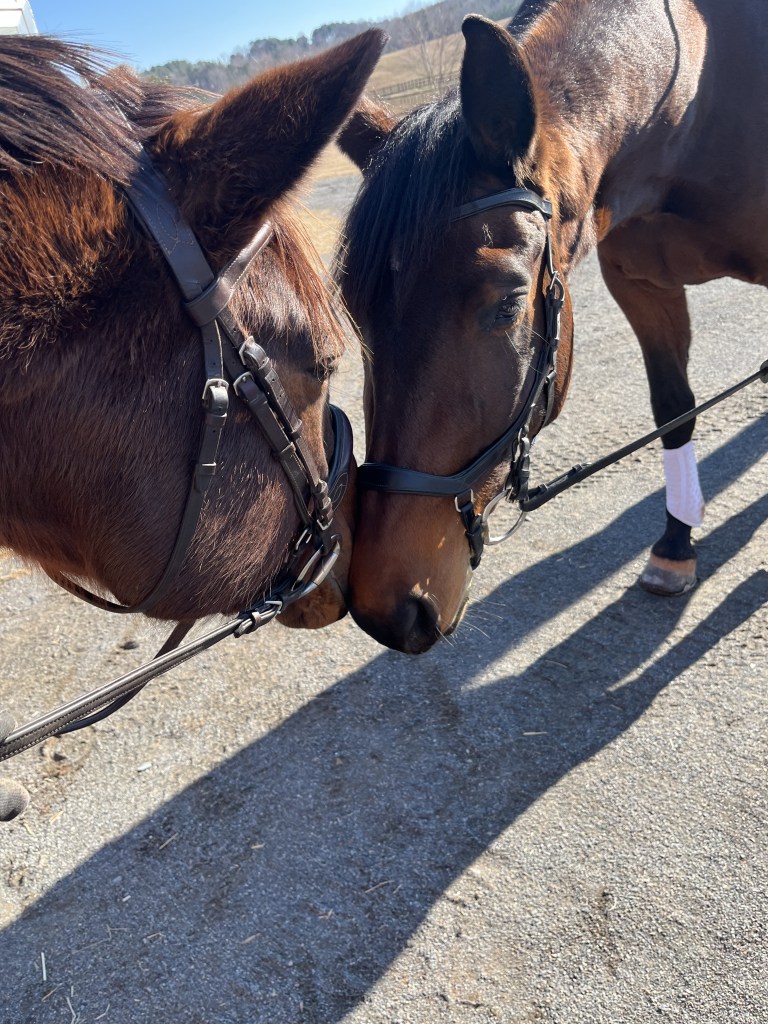
Hanz and Alfie sharing greetings after a long good hack together
My riding overall has been improving at an exponential pace. I absolutely love having my own horse that I can ride whenever I want. It’s such a fulfilling and exciting experience, and it satisfies my ambitious drive to achieve my goals as a rider.
I would say my biggest breakthrough in riding lately has come from realizing just how important it is to develop an independent seat. When I first started riding, I often heard, “More leg! More leg!” or any other axiom we riders through around endlessly. For the longest time, I focused on that advice without truly understanding a deeper and more connected way to ride effectively. What I’ve come to realize now is that, with horses, less is often more. We constantly hear about achieving an inside leg-to-outside rein connection, creating more impulsion from back to front, and ensuring that your horse is “in front of the leg”, and a lot of other sayings. I often reflect on these phrases while riding, trying to apply them in real-time.
For a long time, I believed the order of aids should always be leg first, then seat, and finally hand. I now realize I was sorely mistaken. My biggest weakness in riding so far was failing to understand the profound impact my seat has on my horse’s biomechanics and engagement. I began asking myself: How does my riding truly affect my horse? It’s a question I think every rider should consider. I’ve since discovered that the most effective order of aids involves a much more natural pattern: Seat first, then leg, and finally hand.
Recently, I’ve been reading a fantastic book about classical dressage and its impact on a horse’s biomechanics and way of going. The book is packed with valuable insights, but one idea stood out to me above all others and has transformed my riding for the better: The rider’s independent seat is the command post for all other aids. It is the central aid to all your riding. This simple but powerful concept has fundamentally changed how I think about using aids. It makes perfect sense. We want our horses to respond to our leg aids, but what influences the legs? Moving up from the ankle, we find the calf, then the knee, the thigh, and finally the seat. To be more technical, the hips and pelvis are part of the seat. Why should a horse respond to a lower leg aid if the seat and balance are saying something contradictory? This realization was a game-changer for me.
The aids should work in harmony, like a symphony where every instrument contributes to a wholistic and meaningful piece of music. a sonic passage in sync. Riding has become an art form for me. The aids are like brushstrokes on a canvas or chords on a piano or guitar. The horse is the instrument, and the arena is a blank score waiting to be filled. This realization has inspired me deeply.
During my next ride, I focused on riding with intention through my seat. Hanz turned and worked through the inside leg to the outside rein like a dream. I didn’t even need much leg to work with him. Simply using my seat allowed him to gather an inside bend like I’ve never experienced before. As I warmed up in the arena, all I had to do was engage my seat and core muscles, lifting slightly away from his back to allow the energy to flow from back to front. Hanz responded with a delightful upward transition. Almost no leg was required. It wasn’t just inside leg to outside rein anymore—it was inside seat to outside hand.
I guided him almost entirely with my seat, and he willingly and happily responded to my aids. I felt as though it was his way of saying, “Thank you for not trying to muscle me around.” Horses are such amazing creatures. Most of the time, they’re patiently waiting for us to catch up and finally “get it.” I captured a few minutes of Hanz and me working on that upward transition, and I’d love to hear any thoughts or insights you might have!
Hanz and I working on riding from the seat
Hanz has continued to have stellar rides with this idea in mind. He instantly seems happier, much more willing, and far less confused about what I’m asking him to do in various moments. During one of our rides, we transitioned into a canter using only my inside seat bone as the aid. With a simple adjustment to my position and a subtle change in my hip angle to the inside, Hanz struck into a beautiful canter without hesitation. Did I mention how much I love this horse? Hanz is such an agreeable and willing horse. He has no problem helping me navigate my challenges as an amateur rider, but I know there is still so much for me to learn and understand. I’m incredibly excited about the future and all it could bring. Every moment, I find myself wondering what chord or song we’ll strike next in the ring.
As the days went on and I continued riding, a little pesky idea began to creep into my mind and refused to let go. I’ve been riding in my Black Country jump saddle, but I’ve started to suspect that it doesn’t quite fit me or Hanz as well as I had hoped. This realization is frustrating because I recently finished paying off the saddle and was ready to move on from saddle-related expenses. Generally, I don’t ride in an overly forward position during the trot or canter, but something over the weeks has been telling me that my position in the saddle could be improved. I’ve reviewed and analyzed many of my recent rides, and most of the time, I appear to have a relatively balanced position in the saddle. Even in the videos from my trial rides, this seemed to be the case.
However, I decided to take another closer look at my saddle. My aunt recommended someone who could offer a second opinion, and I decided to reach out. Little did I know, this would lead to another positive change for Hanz’s future.
I had a saddle fitter come double check Hanz who works with a brand called Erreplus. Her name is Courtney Vesel-Seha and she is out of Mebane, NC. Courtney came to the barn to meet Hanz, and we discussed some concerns I had about my saddle. Black Country saddles are well-known for having a balance point that can be too far back for some riders, as well as a stirrup bar placement that doesn’t suit every rider’s build. I shared with her that I felt my position in the saddle wasn’t as perfect as it could be. When she saw the saddle on Hanz, she noted that the tree was too wide for him and the shape wasn’t quite right for his back. While she said the saddle was passable and would work fine, she mentioned that the fit could definitely be better.
Courtney suggested that we try some of her saddles to demo, as I was already leaning toward getting a new saddle. I rode in these saddles in the ring with her watching Hanz’s balance and motion, and I was completely blown away. I have never felt so balanced and quiet in a saddle in my entire life—I was honestly shocked. Below is a clip of me riding in an Erreplus jump saddle. Hanz was actually uphill and balanced beautifully!
Hanz and I working with a new Erreplus demo saddle.
After the ride, we had a ton of fun in the barn discussing how saddles are made. Erreplus is a custom brand, which means everything is tailored to both the rider’s and the horse’s preferences. While I know that custom saddles are expensive and more of a long-term investment, there’s something reassuring about knowing a saddle is fitted to the exact measurements of both horse and rider. There’s no guesswork or uncertainty—it’s as good as it gets for the horse.
As we walked through the barn, we talked in detail about the process, including costs, wait times, and how measurements are taken. I was geeking out over the precision and how she was doing it. It was such a fascinating process! She took several critical measurements of Hanz’s back and made “tracings” of his topline to create a clear picture of his shape at that moment in time. Of course, horses change in musculature over time, but the saddle can be fully adjusted to accommodate those changes as they occur.

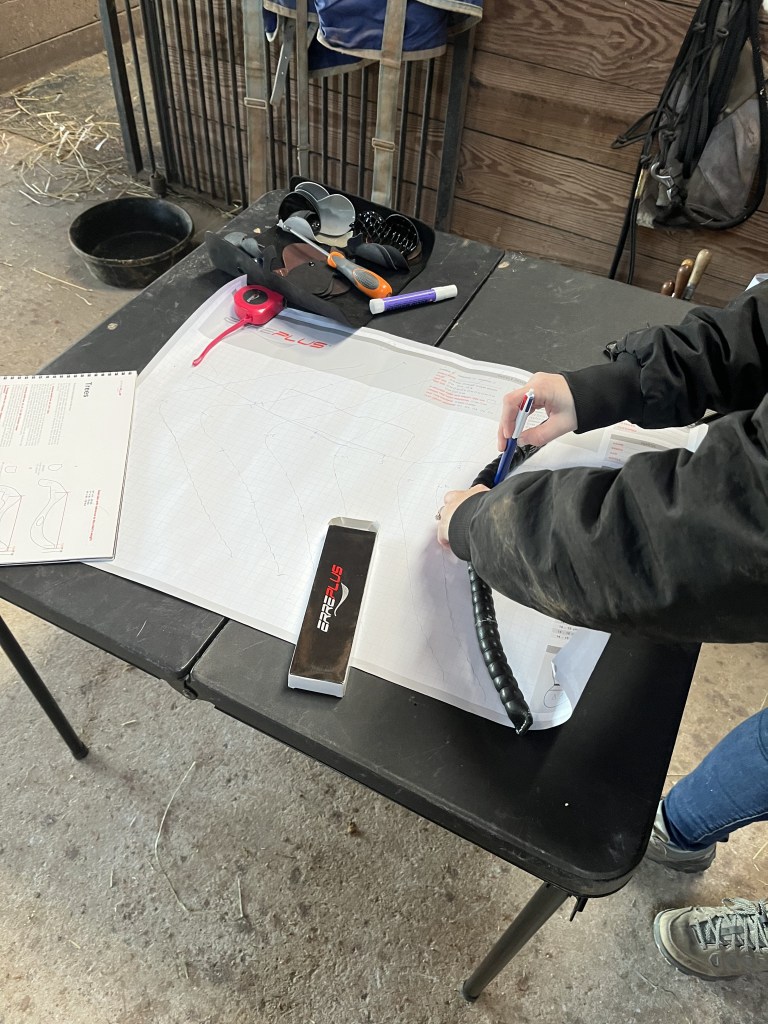
It was one of the coolest things I’ve experienced so far when it comes to saddle fitting. I felt like a pro rider, even though I’m totally an adult amateur who rides on nights and weekends. My favorite part was seeing how Hanz’s topline is shaped and how that influences the requirements for the tree shape and panels of a potential saddle. We determined that I’m a 16-inch seat in this particular brand (dang, I’m tiny)! We also discussed different tree shapes to suit my specific needs as a rider.
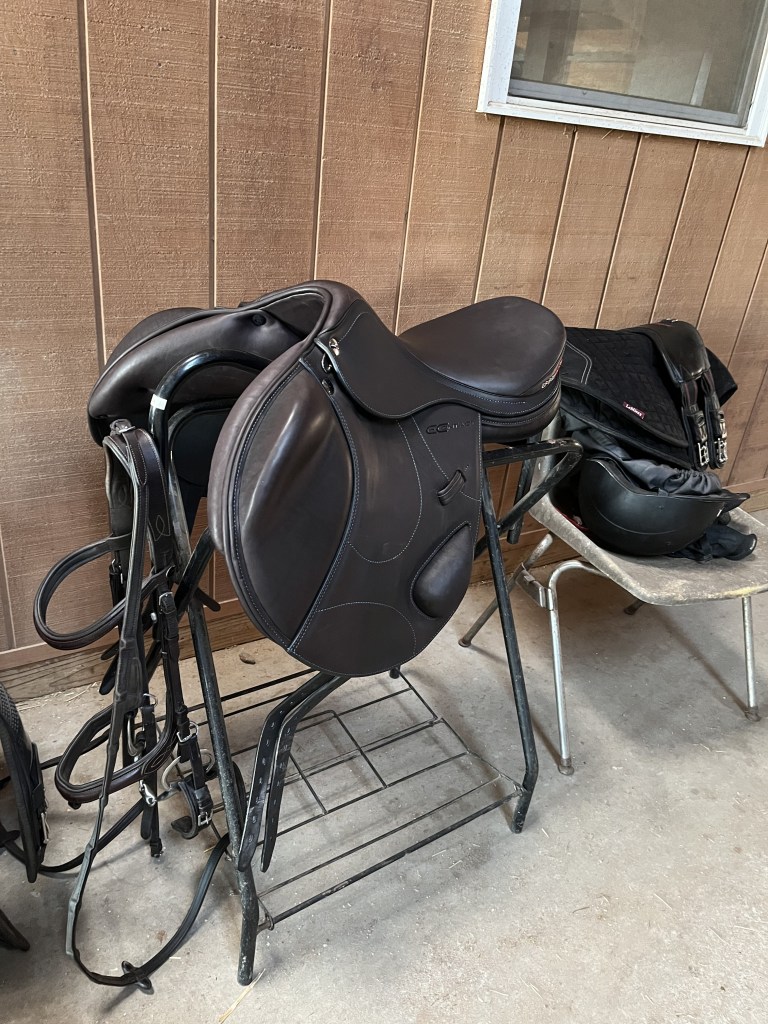
All in all, it was an incredibly fun and educational experience that I enjoyed immensely. I haven’t made a final decision yet regarding the saddle, as it’s a significant investment, but while I take the time to decide, Courtney left me with a fantastic demo saddle that I liked the most. This particular saddle is a monoflap event saddle with a 17-inch seat and a slightly narrower tree. I’m currently demoing it to see if I truly love the brand and want to move forward with an order. I couldn’t be happier or more excited about how things are coming together so far.

In other exciting news, a particularly special event happened in Raleigh, NC, that hasn’t occurred in quite some time—snow! If someone had told me that snow would actually make its way to the South and cause things to shut down for a day or two, I wouldn’t have believed them. While I was at the barn with Hanz, grooming him in the evening, I noticed snowflakes starting to drift through the barn doors. At first, I thought, Oh, it’s just some hay or dirt blowing around. But no, it was definitely not just dirt or hay—it was actual snow! It hasn’t snowed in ages in the Raleigh area.
That night, the temperature had certainly dropped enough for snow, and as I walked toward the barn doors near the wash stalls, it suddenly hit me—it really was snowing! This winter has taught me to be prepared for anything and everything. Hanz was bundled up in his new heavy blanket, which I had recently gotten for him, and I reminded myself that he’s originally from northern Virginia, so he’s probably seen plenty of snow in his lifetime. I took a deep breath and reassured myself that horses are outdoor animals. As long as his heavy blanket was securely on and he had plenty of hay to munch on through the night, he would stay warm and comfortable.
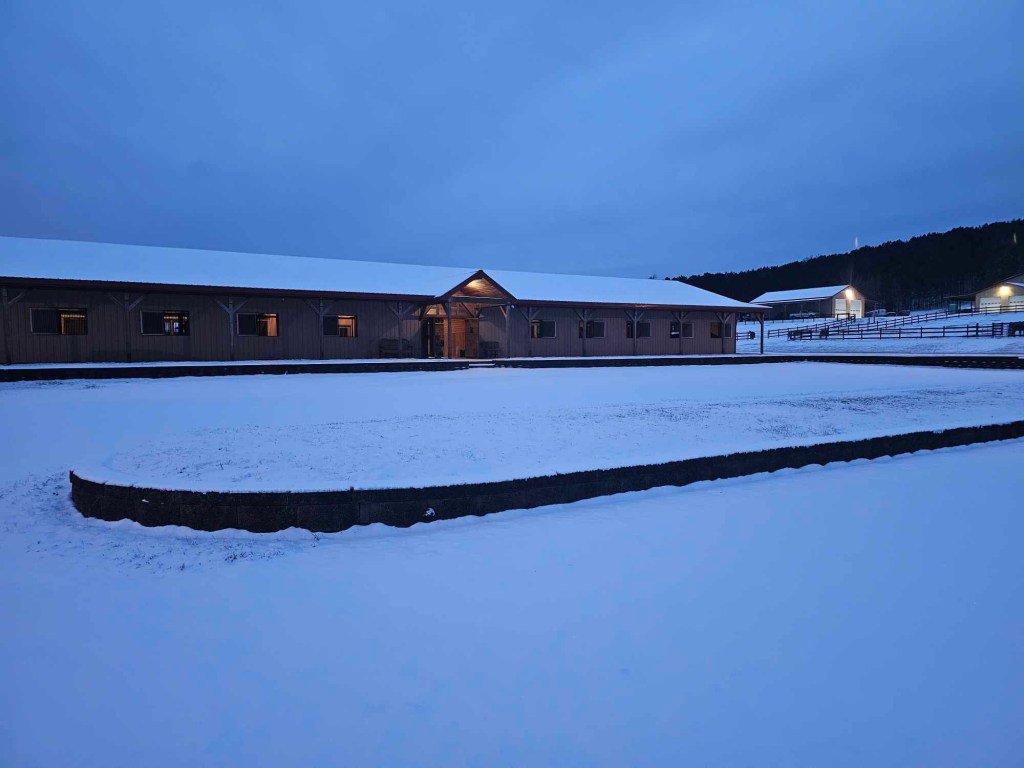
January 22nd, 2025

 "Haz The El" aka "Hanz" - A Throughbred Gelding
Leave a comment